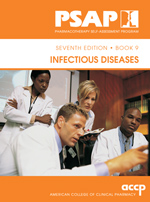
The higher incidence of resistant organisms and the increased need for proper stewardship of treatments require clinical pharmacists to maintain competency in the area of infectious disease. This practice area serves as the focus of the ninth book in the Pharmacotherapy Self-Assessment Program, seventh edition (PSAP-VII). Infectious Diseases provides evidence-based information on the prevention and treatment of common infections.
Infectious Diseases will be released January 17 and has three learning modules offering a total of 19.0 continuing pharmacy education credits. The first module covers HIV Infection, Primary Care in HIV, and Tuberculosis. The second module focuses on Antimicrobial Stewardship, Ophthalmic and Otic Infections, Central Nervous System Infections, and Methicillin-resistant Staphylococcus aureus Infections. The third module covers Bone and Joint Infections, Intra-abdominal Infections, Clostridium difficile Infections, and Influenza. Each chapter provides an update on the topic and includes an extensive annotated bibliography that identifies key research articles, clinical practice guidelines, texts, and Web sites relevant to today’s practicing clinical pharmacist.
Infectious Diseases is designed to assist pharmacists who want to:
- Use current guidelines to determine the appropriateness of patient-specific HIV screening and devise an appropriate plan for antiretroviral therapy for the treatment-naïve patient.
- Recommend appropriate methods for evaluating and managing diabetes, kidney disease, and bone disorders in patients with HIV infection.
- Design an appropriate therapeutic plan for active TB in immunocompetent, immunocompromised, and special populations.
- Evaluate different strategies of antimicrobial stewardship and justify resource use.
- Develop a comprehensive empiric treatment plan, including pharmacologic and nonpharmacologic therapies for various ophthalmic and otic infections.
- Formulate a treatment regimen for patients who present to the hospital with signs and symptoms of bacterial, viral, or fungal meningitis.
- Develop a pharmacotherapeutic plan for the empiric treatment of MRSA infections.
- Given a patient’s clinical symptoms, physical examination, microbiology, and imaging studies, design therapeutic regimens and monitoring plans for bone and joint infections.
- Develop an appropriate empiric antimicrobial regimen for the patient with intra-abdominal infection.
- Design a pharmacologic treatment plan for a patient with Clostridium difficile infection.
- Determine whether antiviral therapy is indicated for an individual with confirmed or suspected influenza infection, and devise an appropriate treatment regimen.
All PSAP-VII books are available in both print and online formats and as either single books or the full series (11 books). Other books in the series are Cardiology; Critical and Urgent Care; Women’s and Men’s Health; Pediatrics; Chronic Illnesses; Oncology; Geriatrics; Science and Practice of Pharmacotherapy; Neurology/Psychiatry; and Gastroenterology/Nutrition.
Each PSAP-VII book offers the most up-to-date and comprehensive information available on recent drug therapy advances and will expand your knowledge in the therapeutic area covered. For specific information on the release date, continuing pharmacy education credits, and program numbers for each book, or to place your online order, visit www.accp.com/bookstore/psap7.aspx. Books are priced as follows; shipping and handling charges apply to print books only.
| |
Member Price |
Nonmember Price |
| Single Books |
|
|
| Print |
$75.00 |
$100.00 |
| Online |
$65.00 |
$90.00 |
| Print and online |
$105.00 |
$130.00 |
| Full Series (11 books) |
|
|
| Print |
$435.00 |
$635.00 |
| Online |
$385.00 |
$570.00 |
| Print and online |
$635.00 |
$820.00 |

ACCP is accredited by the Accreditation Council for Pharmacy Education (ACPE) as a provider of continuing pharmacy education. The Board of Pharmacy Specialties (BPS) has approved PSAP-VII for use in Board Certified Pharmacotherapy Specialist (BCPS) recertification.