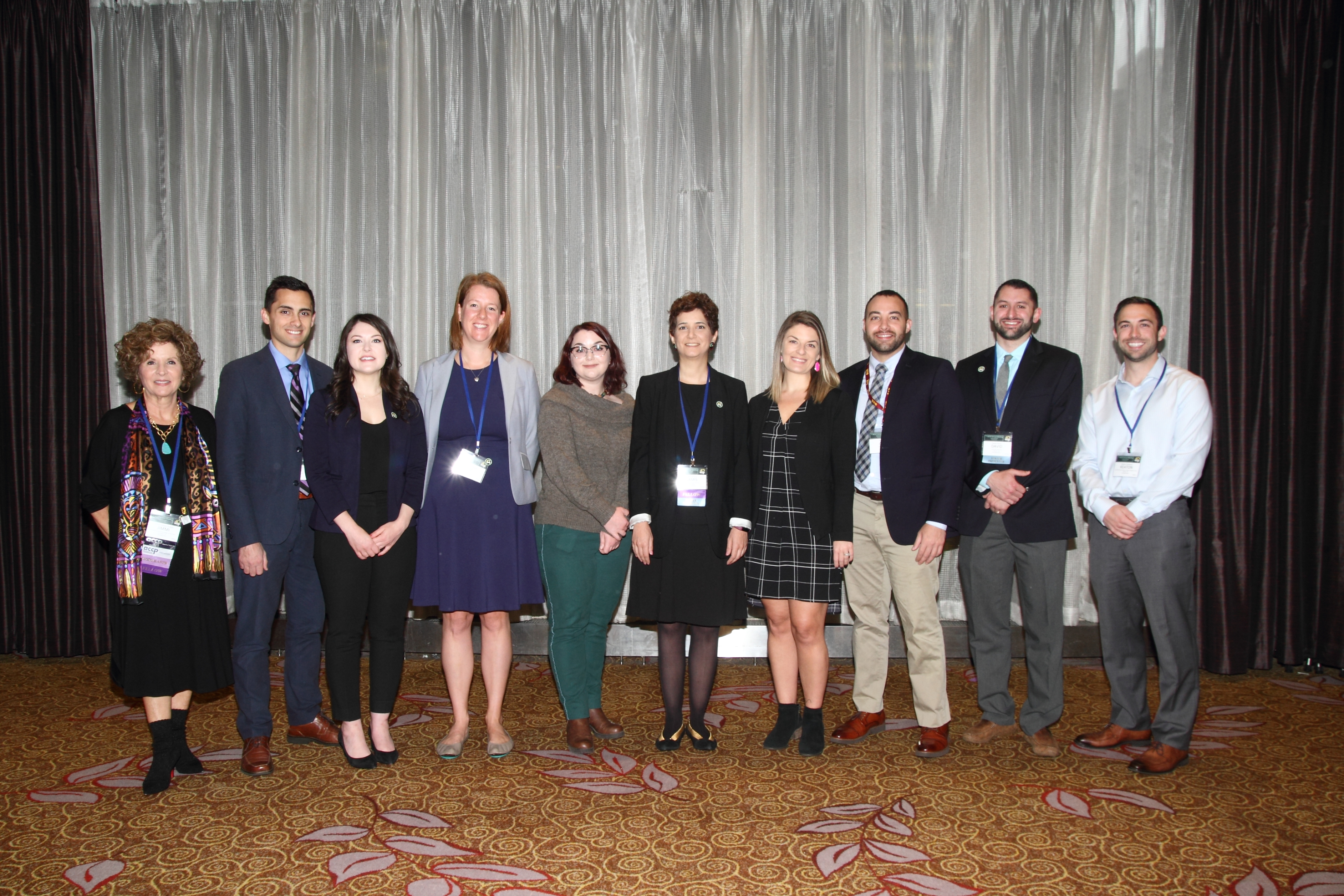
Graduates of the Research and Scholarship Certificate Program, 2019 ACCP Annual Meeting
The Research and Scholarship Certificate Program is an educational program aimed at developing basic clinical research and scholarly abilities. The program integrates research theory with practical applications while involving the participant in scholarly work early in the curriculum. Participants will be challenged to explore individual professional research and scholarly activity goals in order to make the experience as relevant as possible within their respective professional contexts.
A goal of the ACCP Foundation and ACCP is to advance clinical pharmacy and pharmacotherapy through support and promotion of research and research training. The College believes that one of pharmacy’s societal responsibilities is to generate and disseminate new knowledge about pharmacotherapy. This responsibility includes the conduct of translational and clinical research and the translation of research results into practice-based applications. The Research and Scholarship Certificate Program is designed to contribute to this mission. The primary target audience for the Research and Scholarship Certificate Program is residency-trained clinical pharmacists who practice in a setting where involvement in research and scholarly activity is an expectation of their position. Although most of these clinical pharmacists will hold clinical faculty appointments with a school or college of pharmacy, individuals working in hospitals, community pharmacies, managed care organizations, or other settings may also be involved in research and scholarship.
Syllabus
The Research and Scholarship Certificate Program curriculum includes 20.0 hours of core modules and 4.0 hours of elective programming. Elective opportunities allow participants to explore several related goals including developing a business plan, establishing leadership skill, consulting, precepting students and trainees in selected practice settings, and developing telemedicine. The core modules consist of the following:
- Required Live Modules (In-Person [Annual Meetings] or Virtual)
- Prerequisite Module: Research Primer (4 hours)
Offered in conjunction with ACCP’s Annual Meeting
- Module No. 1: Research Basics (4 hours)
Offered in conjunction with ACCP’s Annual Meeting
- Module No. 2: Statistical Issues (4 hours)
Delivered during the ACCP Academy virtual programming
- Module No. 3: Extending Your Research Tool Kit (4 hours)
Delivered during the ACCP Academy virtual programming
- Module No. 4: Regulatory and Ethical Issues (4 hours)
Delivered during the ACCP Academy virtual programming
Electives (minimum of 4.0 hours)
A total of 24.0 hours is required to complete the program. For complete information on each module’s learning objectives, pre-assignments, and portfolio activities, consult the Research and Scholarship Certificate Program syllabus. Each participant will be given two years to complete the certificate program from the time of enrollment.
Program Completion Deadline
The ACCP Academy requires all enrollees to complete the program within two years enrollment in the Research and Scholarship Academy certificate program.
To be eligible for graduation, enrollees must complete the required modules and electives. In addition, all portfolio assignments should be completed by August 1 of the year of graduation.
To qualify for graduation, Research and Scholarship Certificate Program participants must complete required reading, 20.0 hours of required modules and 4.0 hours of electives. Participants must attend the Prerequisite Module: Research Primer prior to receiving credit for any other required modules. The remaining required modules can be taken in any order.
In addition to completing the 20.0 hours of required modules and 4.0 hours of elective modules, each participant must develop and maintain an online electronic portfolio via the online system developed and maintained by ACCP. The electronic portfolio will serve as the guiding and monitoring tool for professional advancement over the course of the program. Portfolio development will be initiated following the completion of the prerequisite module. Completion of the assigned portfolio activities will be required within six months of taking the module and prior to participating in the next module. All portfolio assignments must be completed by August 1st of the year intended for graduation.
For more information about the certificate requirements, accessing the portfolio and required reading, view the syllabus.
To enroll into the Research and Scholarship Certificate Program, enroll online or download the enrollment form. Fees for the Research and Scholarship Certificate Program have been established with today's institutional budget in mind. . A one-time application fee of $399.95 for members and $699.95 for nonmembers (to offset expenses for online portfolio maintenance) will be charged upon enrollment in the program. Your enrollment fee includes access to all programming requirements virtually including the prerequisite module, modules 1, 2, 3, and 4, and electives. All programming will be delivered live via Zoom and recordings made available to participants in your ACCP Account.
Three-Month Grace Period: Required and elective programming completed three months before enrollment, will apply towards the certificate.
Questions? Visit the FAQs page or contact Wendy Staab.