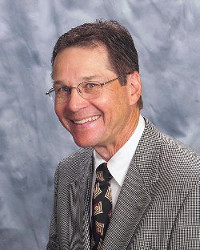
Robert M. Elenbaas, Pharm.D., FCCP, has been chosen by the Parker Medal Selection Committee as the 2013 recipient of the College’s Paul F. Parker Medal for Distinguished Service to the Profession of Pharmacy. Dr. Elenbaas, now retired, was a pioneer in establishing patient care responsibilities in the emergency department at Truman Medical Center in Kansas City, Missouri, in the 1970s and 1980s. He later became the founding executive director of the American College of Clinical Pharmacy.
Paul Parker was one of clinical pharmacy’s most influential proponents. Before his death in 1998, Dr. Parker spent 24 years as director of pharmacy at the Chandler Medical Center/University of Kentucky in Lexington. His innovations include developing decentralized pharmacy services, placing pharmacists in the hospital’s clinical areas, and developing the nation’s first pharmacist-staffed drug information center. Dr. Parker’s vision for pharmacy practice was passed along to the more than 150 residents and fellows who trained in the Kentucky program during his tenure. These disciples include many of today’s leaders in clinical pharmacy who continue to pass on his wisdom and vision to their trainees. The Paul F. Parker Medal recognizes an individual who has made outstanding and sustained contributions to the profession that improve patient or service outcomes, create innovative practices, affect populations of patients, further the professional role of pharmacists, or expand the recognition of pharmacists as health professionals.
In making its selection, the Parker Medal Selection Committee commented on Dr. Elenbaas’s many contributions to clinical pharmacy and the pharmacy profession, noting that “his accomplishments in the field of emergency medicine set the stage for many practices today. He developed a stature among his peers and colleagues in that field, including physicians, that brought him and clinical pharmacy to national prominence.” The committee went on to say,
When Dr. Elenbaas took the helm of ACCP as its first executive director, the College grew to prominence under his leadership. It was critical during those years that ACCP become recognized as one of pharmacy’s leading organizations and that it develop a stature similar to other national pharmacy organizations. His leadership was central to that accomplishment.
Dr. Elenbaas’s career has encompassed numerous key roles in the development of ACCP and the clinical pharmacy discipline. He served as chair of the American Association of Colleges of Pharmacy Section of Teachers of Clinical Instruction (1980–1981), cochair of the Committee on Clinical Pharmacy as a Specialty (1981–1987), ACCP secretary (1983–1985), ACCP president (1986–1987), chairman of the Pharmacotherapy Board of Directors (1994–2002), and secretary of the ACCP Research Institute Board of Trustees (1986–2006).
Dr. Elenbaas has received many awards, including the Distinguished Alumnus Award from the University of California at San Francisco, the Robert G. Leonard Lecture Award from the University of Texas at Austin, and the Thomas J. Garrison Achievement Award from the Missouri Society of Hospital Pharmacists. He has been elected as a Fellow of both the American Pharmacists Association and ACCP and, in 2004, was inducted as a member of the Academy of Pharmacy Practice of the National Academies of Practice.
Dr. Elenbaas’s nominator, Jerry Bauman, dean and professor at the University of Illinois–Chicago College of Pharmacy, wrote in his letter of nomination,
I would say nearly all of the clinical pharmacists practicing in the ED [emergency department] today can trace their roots back to Bob Elenbaas. He shared his experiences in the literature; the very first description of the role of clinical pharmacists in the ED was published in 1977 (Am J Hosp Pharm 1977;34:843-6) with coauthors and internationally regarded ED physicians Joe Waeckerle and Kendell McNabney. I was fortunate to spend 4 months in the ED with Bob during my education and training at UMKC [University of Missouri–Kansas City] and I can personally attest to the unique practice that Bob created. By the time I arrived, Bob had reached the stature of “senior attending” in the ED, and he took responsibility for the entire care of all patients with drug-related problems (e.g., seizures, asthma, overdoses, adverse drug reactions) and led cardiac resuscitation teams. Note that this was the mid-1970s! The level of respect accorded him by physician and nurse colleagues, his status in the ED, and his clinical expertise and capabilities as a clinical pharmacist were astounding to me at the time. . . . I consider myself extremely fortunate to have experienced this clinical setting and to have been influenced by Bob and his incredible capabilities.
Barry Carter, Patrick E. Keefe Professor in Pharmacy at the University of Iowa College of Pharmacy, wrote in his letter of support,
When I first became a faculty member in 1981, Dr. Elenbaas was a clinical pharmacist in the Emergency Department at the Truman Medical Center. . . . He was also leading the effort to have Clinical Pharmacy (subsequently renamed Pharmacotherapy) recognized as a specialty. Later, in 1986–1987, when I was a junior faculty member, he was the President of ACCP. I was always in awe when I heard Dr. Elenbaas speak, provide reports at ACCP meetings, and as we observed him lead the profession. He was clearly one of the most influential individuals in the infancy of ACCP and its later development. However, when I really got to know Bob about 10 years later, I found him to be one of the most humble and kind individuals I know. He was always satisfied with letting others shine, even though he was ever so subtly providing much of the wisdom and support behind a project or activity. I am clearly indebted to Bob for all he did for me to be successful within ACCP. He made us all look good.
Joseph DiPiro, Pharm.D., executive dean of the South Carolina College of Pharmacy, added in his letter to the selection committee,
My overall assessment is that Dr. Elenbaas has had more positive influence on the development of clinical pharmacy than just about anyone else. . . . Through his leadership in ACCP, Dr. Elenbaas played a major and pivotal role in establishing the discipline of clinical pharmacy at a critical time when it was just getting off the ground in the U.S. Our field would not have come as far as it has if it were not for the organizational leadership, structure, and direction that ACCP has provided. Dr. Elenbaas is the major reason that ACCP developed from an organization of a few hundred members when he started as Executive Director in 1986. . . . During his time at ACCP, the College wrestled with and worked through many thorny issues in pharmacy and health care. Having seen it in person, I know that he provided the guiding hand, the insight, and the wisdom that was behind many of the advances that ACCP made through the Board, committees, and PRNs. He assured that ACCP was always at the same table with other major pharmacy organizations. Dr. Elenbaas has been one of the most highly respected members of our profession. He has a unique talent for analyzing complex situations and organizing an approach to make progress . . . an organizational mindset that is far superior to most others in our profession. . . . He has either led or had substantial influence on many of the important milestones in clinical pharmacy over the past 30 years.
In closing his letter, Dr. Carter wrote,
I firmly believe that Bob was the consistent, long-standing and instrumental force within ACCP that led critical patient care advancements within the profession of pharmacy. Here are just a few of the major projects Dr. Elenbaas’ leadership developed, guided and promoted: 1) Board Certification in Pharmacotherapy, 2) the Pharmacotherapy Self-Assessment Program (PSAP), 3) provider status for pharmacists (especially the leadership to develop the Government Affairs group in ACCP), and 4) the Pharmacotherapy Preparatory Review Course. There are many more examples, as well.
The 2013 Paul F. Parker Medal will be presented during the Opening General Session at the 2013 ACCP Annual Meeting in Albuquerque, New Mexico, on Sunday morning, October 13. Dr. Elenbaas will attend to accept the medal and deliver a brief acceptance address. The Parker Medal Selection Committee is composed of representatives from member organizations of the Joint Commission of Pharmacy Practitioners, together with past presidents of ACCP. Members of the 2013 committee are William Kehoe (chair), Gilbert Burckart, Rodney Carter, Diane Ginsburg, James (Rusty) Hailey, John Murphy, Jenelle Sobotka, George Spratto, Glen Stimmel, and Barbara Wells.