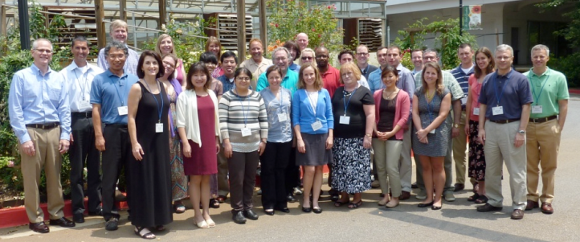
FIT Class of 2013
Front Row: Susan Fagan, Grace Kuo, Dhara Shah, Kathryn Momary, Catherine O’Brien, Lynda Welage, Ruth-Ann Lee, Emma Tillman, and Reggie Frye
Second Row: Song Hong, Meghan Jeffres, Mary Ensom, Gary Yee, Ron Reed, Henry Young, Scott Monte, Dan Hertz, Hassan Almoazen, Julie Oestreich, and Stacy Voils
Back Row: Sheldon Holstad, Jeffrey Gonzales, Robbie Parker, Kalen Manasco, Vicki Ellingrod, Gene Morse, Greg Stoddard, John Cleary, Mary Gerkovich, Donald Harvey, Michael Dorsch, Chris Wood, and Matt Kelso
Last month, 20 investigator participants, the largest class to date, and 12 faculty mentors teamed up for 5 days of intensive proposal development work at the University of Georgia College of Pharmacy (from July 27 to 31, 2013). Central to the Focused Investigator Training (FIT) Program were five small-group grant proposal development sessions. Led by two experienced and funded mentors, three or four mentees worked on their individual research proposals beginning with “Writing Killer Aims” and working through to a “Budget, Project Management, and Next Steps Toward Implementation” session. Combining these small-group proposal development sessions with tip-rich lectures and discussions, one-on-one mentor appointments, and after-hours proposal revisions by investigator participants, significant progress was made in retooling proposals by program’s end.
As part of the program, participants wrote reflection papers on their experiences during the FIT. Here are just a few excerpts:
I could summarize my FIT experience by simply saying that, for me, it was certainly a week of specificity and focus. As with many things in life, the rewards of honing in on a topic are many—whether it’s a research project, career goal, time management, or negotiations (all components of the FIT curriculum). The week reminded me that prior planning prevents poor results, and that perseverance is critical to success.
Knowing where to find funding sources, institute funding rates, and how a review panel works was exceptionally helpful. As was the persistent message of writing with the reviewer in mind. I had no idea I could help steer which study section a grant could go to.
I realized that I’m far too verbose and nonspecific in my writing. I often don’t take the opportunity to reiterate and drive a critical point home.
The most significant “a-ha moment” is probably realizing that an R15 would be a great fit for me.
I wish I [had known] what a K award was at the end of my residency. I believe my career path would have been dramatically altered.
Prior to this workshop, I really didn’t understand the point of the K award, so I was completely unprepared to craft a competitive application.
I learned that one of my aims is not at all novel. Something I think I knew but couldn’t accept until I was forced to defend it.
I realize now that I am actually farther from applying than I had originally thought, but my application, when it does get submitted, will be far more competitive than it would have otherwise been. I cannot imagine submitting the proposal that I would have submitted without this training.
My experience with the mentor team was awesome. Not only did the mentors help formulate my grant, but the other mentees helped think through my grant. It was also nice that the mentees and mentors were matched very well. We all knew enough about what each other does to help.
Across the board, there was passion, wisdom, insight, and caring.
The FIT Class of 2013:
Hassan Almoazen
University of Tennessee Health Science Center
Michael Dorsch
University of Michigan
Jeffrey Gonzales
University of Maryland
Donald Harvey
Emory University
Dan Hertz
University of Michigan
Song Hong
University of Tennessee Health Science Center
Meghan Jeffres
Roseman University
Matthew Kelso
University of Nebraska Medical Center
Ruth-Ann Lee
University of North Carolina – Chapel Hill
Kalen Manasco
Georgia Regents University
Kathryn Momary
Mercer University
Scott Monte
University at Buffalo
Catherine O’Brien
University of Arkansas for Medical Sciences
Julie Oestreich
University of Nebraska Medical Center
Ronald Reed
Husson University
Dhara Shah
University of Houston
Emma Tillman
University of Tennessee Health Science Center
Stacy Voils
University of Florida
Christopher Wood
University of Tennessee Health Science Center
Henry Young
University of Georgia
The FIT Program is designed for mid-career clinical pharmacy researchers who have not yet received substantial federal funding. Watch www.accpri.org for the next FIT Program announcement and application information, or call the ACCP Research Institute at (913) 492-3311 for additional information.
Visit www.accpri.org/fit to see evidence of some of the fun experienced during the 2013 program.