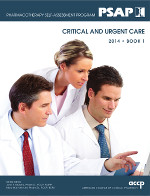
The clinical pharmacist often encounters patients with serious or life-threatening complications that require immediate therapy. Critical and Urgent Care, the next release in the Pharmacotherapy Self-Assessment Program (PSAP), presents the latest evidence-based information on the pharmacologic management of disorders commonly seen in ICUs, emergency departments, and medical/surgical wards.
The first module examines cardiac arrest and advanced cardiac life support; care of the patient with acute burn injury; antibiotic use in patients receiving continuous renal replacement therapy; and off-label drug use in the ICU. The focus shifts in the second module to thrombolytic therapy in the patient with acute ischemic stroke; thrombotic and bleeding diatheses; and infection (in critically ill patients), as well as pain, agitation, and delirium in the ICU. The third module discusses the care of the kidney transplant recipient, the management of severe sepsis and septic shock, and the rare, but potentially fatal, epidermal disorders Stevens-Johnson syndrome and toxic epidermal necrolysis.
Critical and Urgent Care will be released January 15 and has three learning modules with 23.0 available continuing pharmacy education (CPE) credits. The Board of Pharmacy Specialties (BPS) has approved PSAP for use in Board Certified Pharmacotherapy Specialist (BCPS) recertification.
To enhance learning, PSAP chapters are now fully referenced, with online links to literature compilers such as PubMed. In addition, hypertext links provide ready access to clinical practice guidelines, official recommendations, and patient assessment tools. New graphic features focus on pivotal studies, patient care scenarios, and take-home points that can be readily integrated into clinical practice.
Critical and Urgent Care is designed to assist clinical pharmacists who want to:
- Distinguish the major changes in the most recent treatment guidelines for adult advanced cardiac life support in emergency cardiovascular care.
- Describe the role of hypothermia in post–cardiac arrest care to optimize survival and neurologic recovery.
- Develop a fluid resuscitation plan for a patient with burn injury, including weighing the risks and benefits of crystalloid-, colloid-, and hypertonic saline–based strategies.
- Develop a pharmacotherapy plan for a patient on continuous renal replacement therapy by applying the principles of pharmacokinetics, pharmacodynamics, drug removal, and drug dosing.
- Devise a rational approach to assessing evidence-based guideline recommendations for off-label drug use when applied to clinical practice.
- Design an individualized treatment plan for the use of intravenous and intra-arterial thrombolytic therapy in a patient with acute ischemic stroke.
- Develop a plan for monitoring and providing post-thrombolysis care, including blood pressure control, thromboembolic prophylaxis, and antiplatelet therapy, for a patient receiving thrombolytic therapy.
- Apply recent guideline recommendations to develop an appropriate anticoagulant regimen for patients requiring acute treatment of venous thromboembolism.
- Develop a treatment plan for the reversal of novel oral systemic anticoagulants in patients requiring an emergency surgical procedure.
- Identify pathogens associated with ICU infections to design a therapeutic plan to optimize treatment.
- Evaluate a patient’s depth of sedation, analgesia, and delirium using the appropriate bedside assessment scales.
- Assess the immediate and early posttransplant course of the kidney transplant recipient, including complications related to immunosuppressive drugs.
- Develop a treatment pathway for the care of patients with severe sepsis or septic shock that incorporates the 2012 Surviving Sepsis Campaign guideline recommendations and care bundle.
- Distinguish Stevens-Johnson syndrome and toxic epidermal necrolysis from other dermatologic emergencies.
The content of Critical and Urgent Care was developed under the leadership of Faculty Panel Chair Steven E. Pass, Pharm.D., FCCP, FCCM, BCPS. Editors for the 2013–2015 PSAP series are John E. Murphy, Pharm.D., FCCP, FASHP; and Mary Wun-Len Lee, Pharm.D., FCCP, BCPS.
PSAP 2013–2015 books are available singly or as a six-book series and in four format packages. Other books in the series are Cardiology/Endocrinology, Special Populations, Chronic Illnesses, Infectious Diseases, and CNS/Pharmacy Practice. To obtain information on specific release dates and available CPE credits, or to place your online order, visit the ACCP Online Bookstore. Books are priced as follows; shipping and handling charges apply to print books only.
PSAP 2013–2015
| SINGLE BOOKS |
Book Format |
Member Price |
Nonmember Price |
| Standard Release |
Online Book (Printable PDFs) |
$65 |
$90 |
| E-Media Package |
Online book PLUS:
Full text and SAQs for e-reader, phones, tablets
PSAP Audio Companion |
$90 |
$130 |
| Print Package |
Online book PLUS:
Print book |
$90 |
$155 |
| All-Format Package |
All the above products |
$105 |
$195 |
| SIX-BOOK SERIES |
|
|
|
| Standard Release (Online Book) |
Online Book (Printable PDFs) |
$285 |
$385 |
| E-Media Package |
Online book PLUS:
Full text and SAQs for e-reader, phones, tablets
PSAP Audio Companion |
$385 |
$555 |
| Print Package |
Online book PLUS:
Print book |
$385 |
$585 |
| All-Format Package |
All the above products |
$445 |
$785 |