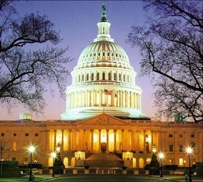
“Congress shall make no law respecting an establishment of religion, or prohibiting the free exercise thereof; or abridging the freedom of speech, or of the press; or the right of the people peaceably to assemble, and to petition the Government for a redress of grievances.” (First Amendment to the United States Constitution)
Introduction
The Constitution of the United States of America does not refer to political action committees (PACs). Nowhere in this great document will you find mention of political campaign advertising, K Street, or bundled contributions. Yet the First Amendment of the Constitution guarantees U.S. citizens and citizen groups (including ACCP) the right to political expression and association – the First Amendment was incorporated in the Constitution, at the urging of James Madison, to protect “indispensable democratic freedoms.”1
Repeatedly, the Supreme Court has held that political expression is “at the core of our electoral process and of First Amendment freedoms.”2 The First Amendment right to “speak one’s mind ... on all public institutions” includes the right to engage in “‘vigorous advocacy’” no less than “‘abstract discussion.’” Advocacy of the election or defeat of candidates for federal office is no less entitled to protection under the First Amendment than the discussion of political policy generally or advocacy of the passage or defeat of legislation.3 Thus, the Court concluded that “it can hardly be doubted that the constitutional guarantee [of the First Amendment] has its fullest and most urgent application precisely to the conduct of campaigns for political office.”4
The ACCP-PAC
ACCP’s 2007 Strategic Plan called for an examination of the feasibility and value of establishing an ACCP-PAC. Based on research conducted by staff and outreach to ACCP membership, the ACCP Board of Regents approved the establishment of a PAC at its February 2010 meeting to support and advance ACCP’s advocacy agenda in Washington, DC.
Why Establish a PAC?
In a representative democracy such as the United States, citizens have the right to contact their elected officials and educate them on issues in order to influence policy outcomes. However, with more than 600,000 Americans in every congressional district, it is logistically impossible for each citizen to build a meaningful relationship with his or her elected official.
Professional organizations such as ACCP therefore offer an alternative way for citizens to connect with elected officials by bringing together a mass of people with shared interests and beliefs on certain areas of public policy. ACCP already engages in direct lobbying, employing two full-time government relations staff in Washington, DC, and in grassroots advocacy, with more than 250 ACCP advocates. A PAC will serve as the third leg in the three-legged stool of political action, together with lobbying and grassroots action.
- A PAC is the only means by which ACCP can provide financial support to help elect pro-pharmacy candidates.
- Political contributions help raise ACCP’s profile in Washington, DC.
- Attending fundraising events offers an opportunity to secure face time with members of Congress or congressional staff.
- ACCP members can also attend events on behalf of the College and help improve their relationships with elected officials.
Legal Overview
A PAC is a legally defined entity organized to help elect political candidates. As the “sponsoring organization,” ACCP would establish a “separate segregated fund” (SSF). ACCP can therefore absorb all the costs of establishing and operating the SSF and soliciting contributions to it, meaning that all money raised goes directly to supporting candidates.
PACs must report all financial activities, including direct donations and other expenses, to the Federal Election Commission (FEC), which makes the reports available to the public. The FEC has strict regulations about how PACs can raise money and how its funds may be used. With certain exceptions, a PAC can receive up to $5000 from each member (per calendar year) and give up to $5000 per candidate, per election (so $10,000 per election cycle – once for the primary election, once for the general election).
The ACCP-PAC can only solicit contributions from its members—its “solicitable” or “protected” class. Because PACs cannot accept corporate contributions, this law puts ACCP in a position of relative strength, compared with corporate or business-related trade associations that represent corporations, not individuals. ACCP, as an individual member organization, has 11,000 members who can contribute to the PAC.
Why Support Your PAC?
The success of ACCP-PAC depends entirely on the support of ACCP members. Although the College recognizes the commitment ACCP members already make to the College and other professional organizations, this is clinical pharmacy’s PAC and, as such, it presents a unique opportunity to raise ACCP’s political profile and advance its advocacy agenda. A PAC will give ACCP members better access to legislators and political parties, as well as invitations to fundraisers where candidates are present and available to engage in policy discussions. Quite simply, not having a PAC puts ACCP at a disadvantage when operating in the political arena.
One of the key objectives of ACCP-PAC is to help ensure that candidates who understand the value of clinical pharmacy and have demonstrated their support for ACCP’s issues are elected to Congress. ACCP’s lobbying and grassroots activities are vital to educating members of Congress and raising awareness around clinical pharmacy issues, but this effort is wasted if ACCP’s friends on Capitol Hill or other pro-pharmacy candidates are unsuccessful in their bids for office.
Finally, a PAC will help maximize the impact of a political contribution. Although individual campaign contributions made by ACCP members directly to candidates are important, such small-dollar donations often go unnoticed in an era of multi-million dollar election campaigns. By giving to ACCP-PAC, contributions will be pooled with those of other clinical pharmacy colleagues to ensure maximal impact.
ACCP will roll out a newly launched PAC in the coming months; look for further updates on how you can get involved in this exciting venture.
ACCP’s New Address in Washington
As a reminder, ACCP’s Washington office has moved. The new address is as follows:
American College of Clinical Pharmacy
1455 Pennsylvania Ave. NW
Suite 400
Washington, DC 20004-1017
Telephone: (202) 621-1820
Fax: (202) 621-1819
References
- Mission statement of the James Madison Center for Free Speech. Available at http://www.jamesmadisoncenter.org/missionstatement.html. Accessed April 1, 2010.
- Appendix 4. The federal election campaign laws: a short history. Available at http://www.fec.gov/info/appfour.htm. Accessed April 1, 2010.
- Motion to quash subpoena in Melvin v. Doe. Available at http://www.aclu.org/technology-and-liberty/motion-quash-subpoena-melvin-v-doe. Accessed April 1, 2010.
- Buckley v. Valeo. 424 U.S. 1 (1976). U.S. Supreme Court. Decided January 30, 1976. Available at http://www.law.umkc.edu/faculty/projects/Ftrials/conlaw/buckleySP.html. Accessed April 1, 2010.