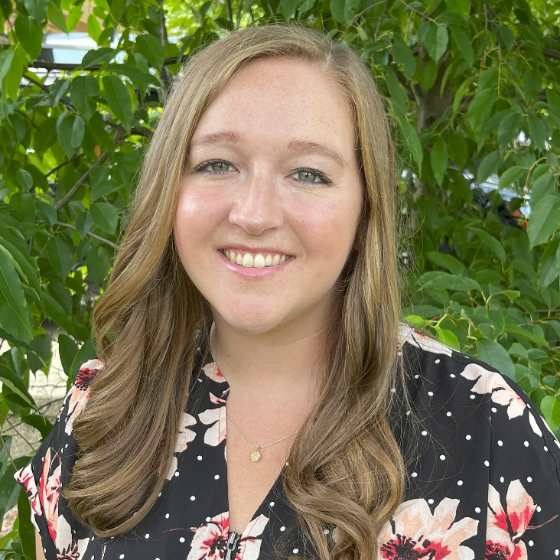
 Cecilia Volk, Pharm.D., is an assistant professor at the University of Wisconsin (UW) Madison School of Pharmacy. Volk earned a BS degree in biochemistry at Northern Michigan University and her Pharm.D. degree at the UW Madison School of Pharmacy. During pharmacy school, Volk identified her passion for translational research while working with her mentor, Dr Warren Rose. After pharmacy school, Volk pursued a PGY1 pharmacy residency at Rush University Medical Center in Chicago, after which she returned to Madison to complete an infectious disease research fellowship with her mentor. After completing her fellowship in July 2023, Volk transitioned into her current position as an assistant professor at the UW Madison School of Pharmacy, where she maintains a clinical practice, teaches pharmacy students, and manages an active research program. Volk’s teaching is largely in the area of infectious diseases, but she also teaches within the Skills Lab at UW Madison. Volk also mentors students in her lab to help inspire research in future pharmacists.
Volk’s research program is currently funded by the KL2 Mentored Scholars Program through the Institute for Clinical and Translational Research at UW Madison, where she concentrates on improving care for patients with infectious diseases by focusing on the interactions between antibiotics, bacteria, and the host immune system using a variety of translational modeling approaches. Her current project is investigating the host-pathogen-antibiotic interactions at play in Staphylococcus aureus bacteremia and determining the effects of different antibiotic therapies on the host immune response. A particularly important part of this work is the development of a novel zebrafish infection model; zebrafish are unique modeling systems, given that their transparency at early ages allows for in vivo imaging of infections and the associated immune response. In her lab, Volk shares her love of research with pharmacy and undergraduate students.
Volk attributes much of her career development to the influence of her research mentor. Rose prioritized Volk’s professional development as early as her first professional year and has offered her opportunities to develop new skills and collaborate with colleagues, many of whom she still works with today. Beyond pharmacy school, Rose’s research fellowship was instrumental in developing Volk’s skills to achieve her goals of a career in academia by integrating clinical practice and teaching opportunities into her research training. To this day, Rose remains a mentor on Volk’s KL2 award and continues to model the highest example of mentorship.
Volk aspires to model mentorship through the way she runs her lab. She attests that communication is a big theme within her research team, especially when onboarding new team members. Volk works with each team member to identify her learners’ communication preferences and goals and tailor their research experience accordingly. She also aims to make lab meetings inclusive and safe places by ensuring that everyone has the chance to be heard.
Every member of my team (including me) takes turns presenting their work and getting feedback and ideas from the group. I believe including myself in this practice sends the message that we are all continually learning and have room to grow with the help of the team.
This theme also extends to Volk’s teaching duties, where she solicits feedback and adapts teaching methods to ensure she is providing information in a way that connects with as many students as possible. Such feedback has led to a landmark change in how she approaches the “gray areas” of patient care. In her courses, students are tasked early on with debating controversial topics in infectious diseases, learning that in some situations, there is no right or wrong answer; instead, clinicians are tasked with finding evidence to support ideas for these unanswered questions.
Volk’s approach to research and teaching clearly supports the advice she offers to other ACCP members, students, and residents.
I would encourage students, trainees, and professionals at any age never to stop taking opportunities to learn and experience new things. During pharmacy school and residency, I think it is important to test out as many different practice sites, patient populations, and practice models as possible. You never know what might spark your interest.
Outside her teaching and research, Volk attests to loving the Wisconsin winter weather, where she can enjoy playing with her puppy, cross-country skiing or snowmobiling, and ice fishing with her family at their cabin.