The Joint Commission of Pharmacy Practitioners (JCPP) convened national pharmacy organization leaders for its summer meeting on June 25 at the Embassy Suites in Alexandria, Virginia. The full-day meeting, titled “Increasing Access and Improving Patient Care Outcomes with Technology,” brought together CEOs, presidential officers, and senior staff from national pharmacy associations to examine how technology, policy, and communication can be leveraged to strengthen patient care across practice settings.
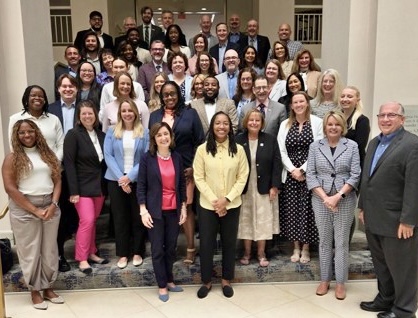
Throughout the day, participants explored real-world models and national strategies in 3 core areas: rural health transformation, health information technology and interoperability, and the critical role of pharmacists as trusted messengers in today’s health care environment.
The morning opened with a panel on state-level Rural Health Transformation projects featuring representatives from Missouri and Alaska, who described how pharmacists are being integrated into care teams to expand access in medically underserved communities. Panelists highlighted technology-enabled services and use of data to demonstrate and document pharmacist service value, payment approaches for pharmacist-provided care, and early impact on patient outcomes. The discussion underscored the opportunity for state and national organizations to support and replicate successful models emerging from these grant-funded initiatives.
A subsequent session with Deputy National Coordinator for Health IT Mark Atalla, Pharm.D., MBA, at the Office of the National Coordinator for Health IT, examined federal efforts to advance interoperability and their implications for pharmacist-provided care. The facilitated dialogue addressed pharmacy data flows, medication and clinical data standards, TEFCA (Trusted Exchange Framework and Common Agreement), and QHINs (Qualified Health Information Networks) and how improved data exchange can enable pharmacists to participate more fully in care coordination and value-based models.
Building on the national perspective, a late-morning panel featuring pharmacists Jeff Rochon of the Pharmacy HIT Collaborative and Frank Harvey of Surescripts focused on interoperability “inside pharmacy,” highlighting practical success stories, remaining barriers, and concrete steps that organizations can take to support the adoption of interoperable systems that facilitate the inclusion of pharmacists in multidisciplinary activities. Speakers emphasized the importance of standards, workflow integration, and sustainable business models for technology investments in both large and small pharmacy settings.
In the afternoon, participants turned to communication and trust in the session “Being a Trusted Messenger,” led by Todd Wolynn, MD, MMM, FAAP, executive director of Trusted Messenger. The session addressed evidence-based communication strategies, steps to counter misinformation, approaches to build trust with patients and communities, and processes by which pharmacy organizations can equip members to effectively explain new care models, digital tools, and access issues to patients, families, and policymakers.
The session concluded with a structured “Takeaways and Next Steps” discussion, during which participants identified areas for follow-up work, including supporting rural health innovation involving pharmacists, advancing priority interoperability use cases, and exploring tools and training to strengthen pharmacists’ roles as trusted professionals.
The summer JCPP meeting was attended in person by ACCP President Denise Rhoney, Executive Director Michael Maddux, Associate Executive Director Sheldon Holstad, and Director of Strategic Initiatives Amie Brooks. JCPP’s next meeting will be held September 17, 2026, at the Embassy Suites in Alexandria.