
For the second consecutive year, members of the District of Columbia College of Clinical Pharmacy (DC-CCP) gathered in Washington for the chapter’s Capitol Hill lobby day. The DC-CCP represents members from across the Washington metropolitan area, including D.C., Maryland, and Virginia. The group met at ACCP’s Washington office to review advocacy materials and talking points before proceeding to Capitol Hill to meet with elected officials from Maryland and D.C.
In keeping with ACCP’s advocacy priorities, the Hill visits focused on our efforts to establish coverage for comprehensive medication management (CMM) services delivered by qualified clinical pharmacists under Part B of the Medicare program. The DC-CCP group educated staff members from the offices of Senators Barbara Mikulski (D-MD) and Ben Cardin (D-MD) and Representative Eleanor Holmes Norton (D-DC) about the collaborative care that pharmacists deliver as part of the team and the process involved in identifying and resolving medication-related problems.
The structure of this policy platform, built on a defined process of care delivered in a team-based manner under collaborative practice agreements, has been almost unanimously well received throughout a 2-year lobbying effort. During this time, we have also been encouraged by the commitment within the health policy leadership on Capitol Hill to a team-based approach to health care that rewards quality and outcomes and recognizes that pharmacist-delivered CMM should be a core component of that delivery model.
That said, we are fully aware of the challenging political and economic environment in which we are operating and the obstacles posed by the Congressional Budget Office’s (CBO’s) approach to developing a cost estimate (or “score”) for legislative proposals. The CBO’s accounting process will recognize only the upfront costs associated with establishing a Part B CMM benefit, not the savings that will inevitably accrue from “getting the medications right”—such as avoiding costly hospitalizations and emergency department visits.
However, senior staff in key congressional and committee offices in both the House and the Senate have made it clear that our policy proposal is aligned in the same direction as the Medicare payment and delivery policy. We are optimistic that our advocacy goals will be achieved by remaining “on-message” and focused on patients and the process of care clinical pharmacists deliver, rather than on payment and “provider status” alone.
Overall, the Second Annual DC-CCP Capitol Hill Lobby Day was successful and enjoyable. ACCP would like to thank the leadership of the D.C. chapter and the Howard University College of Pharmacy student chapter for their hard work and commitment to ACCP’s advocacy agenda. The importance of constituent engagement in the political process cannot be overstated, whether in Washington, D.C., or back home during congressional recesses or “district work periods.”
ACCP encourages all members to visit its Legislative Action Center to learn more about their members of Congress and ways to contact them to urge their support for ACCP’s Medicare Initiative or invite them to visit members’ practice sites and better understand the work they do in providing care to patients as part of the health care team.
Any ACCP chapter or individual member interested in visiting Washington to lobby on Capitol Hill should contact ACCP’s Washington office, where staff can help facilitate and support members’ advocacy efforts.
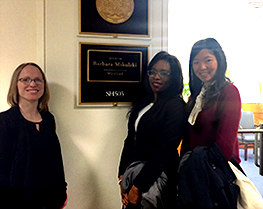
DC-CCP members prepare to meet with the office of Senator Barbara Mikulski of Maryland
From left to right: Lisa Peters, Pharm.D., BCPS, Clinical Pharmacist, Washington Hospital Center, DC-CCP President; Safiya Ransome (Student Pharmacist, College of Pharmacy – Howard University and President of the Howard University ACCP Chapter); and Flora Kuo (Student Pharmacist, College of Pharmacy – Howard University)
House Approves Repeal of Sustainable Growth Rate Legislation
While ACCP members were discussing the importance of Part B CMM coverage as part of a modernized, cost-effective, and quality-focused Medicare program, policy-makers in the House of Representatives were closing in on a compromise that could result in the permanent repeal of the Medicare Sustainable Growth Rate (SGR). This development came as a surprise to all who have observed the fiercely partisan tone that has come to characterize congressional activities.
The Medicare SGR system was put into place as a result of the Balanced Budget Act of 1997 and was designed as a means for CMS (Centers for Medicare & Medicaid Services) to regulate spending on Medicare physician services by linking payment levels to economic growth. In recent years, the formula used as part of the SGR system has recommended drastic cuts to payments for Medicare physicians. Congress has stepped in 17 times with temporary fixes to avoid these cuts. However, each deferral simply increased the size of cuts that would be imposed in subsequent years—cuts of 4.8% recommended under the SGR in 2002 have ballooned to 21% in 2015.
Most health policy experts agree that the SGR approach is fundamentally flawed because it provides no incentives for providers to restrain volume or improve quality. However, the cost of eliminating the SGR (currently estimated at $175 billion) and the debate over how to pay for it have blocked congressional attempts to reach consensus for a permanent repeal. In 2014, a bipartisan, bicameral repeal package won the endorsement of the AMA (American Medical Association), but passage stalled in the House over concerns about the proposal’s impact on the budget deficit.
On March 26, 2015, by a margin of 392-37, the House approved legislation that would replace the SGR with a system that would provide payment increases for physicians over the next 5 years as Medicare transitions to a new system that is based on quality, value, and accountability. The entire legislative package is expected to cost around $200 billion, but it includes around $70 billion in offsets financed primarily through premium increases for higher-income beneficiaries and changes to “Medigap” supplemental insurance plans. According to the CBO, the repeal will add $141 billion to the budget deficit. Click here to read more about the House-passed measure and for background on the SGR issue.
The Senate adjourned without taking up the measure; however, Senate members are expected to begin deliberations when they return from a 2-week recess on April 13. Majority Leader Mitch McConnell (R-KY) indicated that the Senate would take up the legislation as its first order of business and expressed confidence that the measure would be approved by a wide margin. However, Senate Democrats may propose amendments to the House language that would extend the life of CHIP (Children’s Health Insurance Program) for 4 years, instead of 2, and remove language in the bill that restricts the use of federal funds for abortions. In addition, Senator Ben Sasse (R-NE) objected to the legislation’s $141 billion increase in the federal deficit, and other fiscally conservative Senate Republicans may rally around that position. Despite the public assurances from Senate leadership that the measure will pass smoothly, these remaining issues could derail the process. [Editor’s Note. On April 14, the Senate passed the “Medicare Access and CHIP Reauthorization Act of 2015,” completing congressional action that officially repeals the SGR approach. See https://www.congress.gov/bill/114th-congress/house-bill/2/text].
ACCP expressed support for the House-approved SGR repeal legislation in comments submitted to the House Energy and Commerce Committee. The comments called on Congress to enact reforms to the Medicare Part B program that would allow coverage of CMM services provided by qualified clinical pharmacists as members of the patient’s health care team. Click here to read ACCP’s comments in full.
To enhance access to high-quality care and ensure the sustainability of the Medicare program as a whole, it is essential that health care advocates facilitate and aggressively promote progressive payment and delivery system improvements. This especially applies to those systems that measure and pay for quality and value, not simply volume of services, and that fully incentivize care that is patient centered and team based. ACCP is confident that our Medicare Initiative is consistent with these goals, and we will continue to work with our friends and allies on Capitol Hill to integrate coverage for CMM services within the evolving Medicare program.
Contact Us! For more information on any of ACCP’s advocacy efforts, please contact:
John K. McGlew
Director, Government Affairs
American College of Clinical Pharmacy
1455 Pennsylvania Avenue NW
Suite 400
Washington, DC 20004-1017
(202) 621-1820
[email protected]