Undergraduate training for the bachelor of pharmacy degree (BPharm) in Uganda was pioneered in 1988 at Makerere University, Kampala. Today, with around 150 individuals graduating with BPharm degrees each year1 and over 1400 practicing pharmacists registered with the Pharmaceutical Society of Uganda (PSU) – the professional body for pharmacists in Uganda – less than 8% are employed in government hospitals or other direct patient care institutions. Indeed, today’s graduates and practicing pharmacists are mainly involved in supply chain and policy formulation activities, leaving a gaping demand for direct patient care pharmacy services, especially in rural hospitals in Uganda.1 In accordance with the pharmacy council’s mandate, PSU has proposed a new pharmacy service structure in the Ugandan government sector. This is expected to create at least 5000 clinical pharmacy positions within the next 3 years if adopted by the Ministry of Public Service.
Because of the lack of advanced clinical pharmacy training opportunities within Uganda, the pharmacy profession there has somewhat stagnated over the years, with more than 90% of pharmacists exploring more opportunities in pharmaceutical manufacturing, regulation, and supply chains. Fortunately, through a World Bank–funded project – Pharm-BioTechnology and Traditional Medicine Center (PHARMBIOTRAC) at Mbarara University of Science and Technology – the first master of pharmacy in clinical pharmacy degree program (MPharm Clinical Pharm) in Uganda was accredited by the Uganda National Council for Higher Education (NCHE) in August 2018,2 with the first class expected to graduate in October 2020 (Table 1). However, pertinent challenges still facing clinical pharmacy training in Uganda include the lack of adequate clinical exposure during undergraduate training, the small number of clinical pharmacy training programs (Table 1), the small number of qualified preceptors, and the lack of structured student exchange and residency programs within and outside Uganda.
Although efforts to amend the Pharmacy and Drugs Act of 1971 may prove challenging, the ongoing health care restructuring efforts, the global paradigm shift in pharmacy practice from product focus to patient-centered care, the overwhelming burden of pharmaceutical product imports (worth $300.8 million annually), the increasing need for interprofessional collaborative practice in health care, the increasing risk and incidence reports of drug-related morbidity and mortality,3 and the rampant reports of unnecessary medicine expiries in drug stores4 serve as good justifications for the government to invest in clinical pharmacy training in Uganda. Given the developed clinical pharmacy training systems in other countries, establishment of student and teacher exchange programs through strategic collaborations remains fundamental in advancing clinical pharmacy training in Uganda.
Prospectively, with two other universities in Uganda anticipating accreditation to offer clinical pharmacy training by the end of 2021, it is important for PSU to take the lead in consolidating stakeholder efforts to develop clinical pharmacy curricula, amend government policy, and establish student exchange programs and clinical pharmacy specialty/subspecialty boards. As a positive gesture to advance pharmacists’ capacity in public and nonprofit private hospitals, the government of Uganda through the Ministry of Health has awarded 10 scholarships since 2018 to aid in the training of clinical pharmacists.5
Table 1. Pharmacy Training Across All Accredited Universities in Uganda
a
| Description | BPharm Degree | MPharm Clinical Pharm Degree |
|---|
| Accredited institutions | Mbarara University of Science & Technology (MUST), Makerere University, Kampala International University | MUST |
| Duration (yr) | 4 | 2 |
| Student enrollment/yr | 200 | 20 |
| Entry criteria | Must have successfully completed advanced secondary education with at least a “B” in chemistry and biology |
- Successfully completed undergraduate pharmacy training
- Registered with the Pharmaceutical Society of Uganda (PSU)
- At least 2 yr of experience in hospital or community pharmacy practice
|
| Completion rate (%) | 781 | 100b |
| Experiential placement | One-year mandatory internship in hospital/regulatory/pharmaceutical supply chain facilities | Advanced pharmacy practice experiences (APPEs) at Mbarara Regional Referral Hospital |
| Pre-licensure examination | Pre-internship examination: After successful graduation from pharmacy school. Prerequisite for internship placement
Pre-registration examination: After successful completion of a 1-yr mandatory and supervised internship. A requisite qualification to register with PSU | None |
| Major curriculum content | Year 1: Biochemistry, physiology, anatomy, organic chemistry
Year 2: Pathology, pharmacology, physical pharmacy, pharmacognosy, veterinary pharmacy
Year 3: Dosage forms, pharmaceutical engineering, pharmaceutical care, parenteral preparations, radiopharmacy, pharmaceutical chemistry, pharmacoeconomics
Year 4: Pharmacy law and ethics, community pharmacy practice, biotechnology and drug development, pharmaceutical microbiology, pharmaceutical care
|
Year 1: Pharmacoepidemiology, clinical pharmacokinetics, pharmaceutical care in infectious and noninfectious diseases, biweekly APPE report presentationsc
Year 2: Emergency and critical care, complementary medicines, community health and pharmacy practice, biweekly APPE report presentationsc
|
| Research | Fourth-year project: ≥ 98% are pharmacognosy oriented
| Year 2: Clinically oriented in area of major
|
aUndergraduate and postgraduate pharmacy training curricula are unified across all accredited institutions by the National Council for Higher Education (NCHE) in Uganda.
bThe first clinical pharmacy class of 2018 at MUST is expected to graduate on October 1, 2020. The class consists of 23 students (6 females, 17 males), 5 of whom are already employed by the government.
cAPPEs: Clinical disciplines are divided into major and minor electives. Major electives: Emergency/critical care, internal medicine, pediatrics, oncology clinic. Minor electives: Ambulatory care clinics (HIV/AIDS, cardiology, diabetes, renal, and tuberculosis), surgery, obstetrics/gynecology, psychiatry. Year 1 – Two months of mandatory and supervised APPEs across all major electives. Year 2 – One year of mandatory and supervised APPEs in individual student major and minor elective rotations.
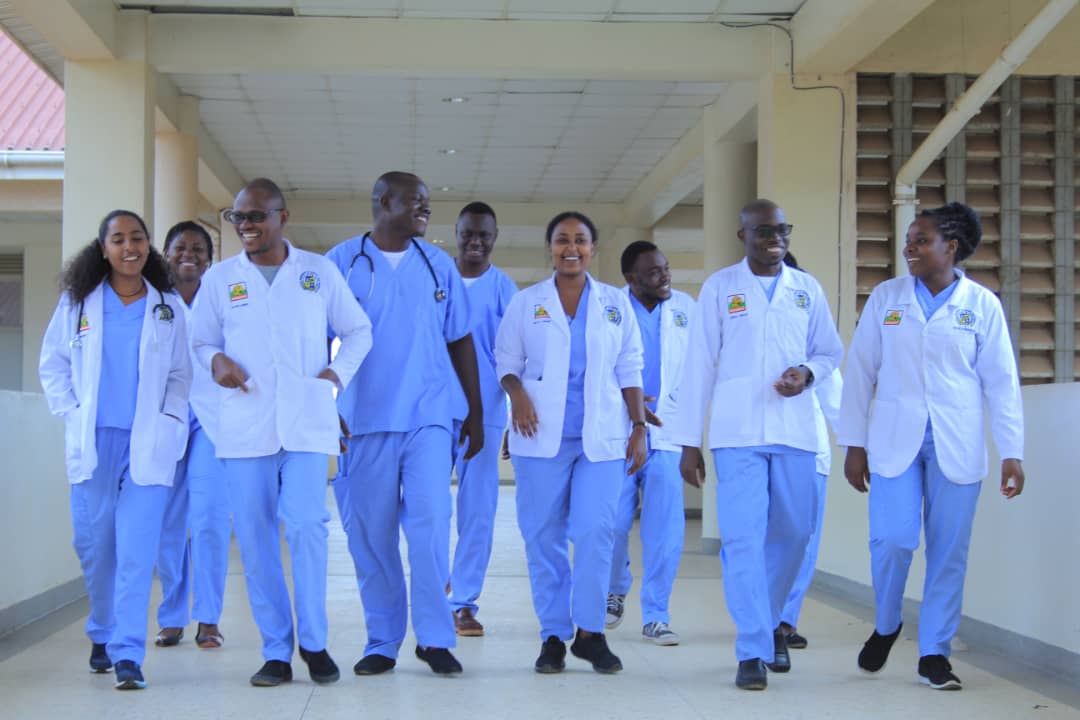
Trainees enrolled in the MPharm Clinical Pharm degree program at Mbarara University of Science and Technology
- Ministry of Health, Republic of Uganda. Annual Pharmaceutical Sector Performance Report 2014–2015. Published June 2016. Available at http://health.go.ug/sites/default/files/2014-2015%20APSPR%2002102016%20final.pdf. Accessed June 8, 2020.
- National Council for Higher Education (NCHE). Accreditation/Programs. Available at
https://unche.or.ug/webpages/programlist.aspx. Accessed June 9, 2020.
- National Drug Authority (NDA). Adverse Drug Reaction Reporting October – December 2019. Published January 17, 2020. Available at https://www.nda.or.ug/?ddownload=4569. Accessed June 8, 2020.
- Republic of Uganda, Ministry of Finance, Planning and Economic Development. Performance of the Economy Report, September 2019. Available at https://www.finance.go.ug/sites/default/files/Publications/September%202019%20Performance%20of%20the%20Economy%20Report.pdf. Accessed June 8, 2020.
- Republic of Uganda, Ministry of Health. Announcement of Scholarships for Academic Year 2018/2019 [press release]. Published August 2018. Available at https://www.health.go.ug/sites/default/files/Min.%20Health_scholarships%20Re-advertised%20%281%29.pdf. Accessed June 8, 2020.